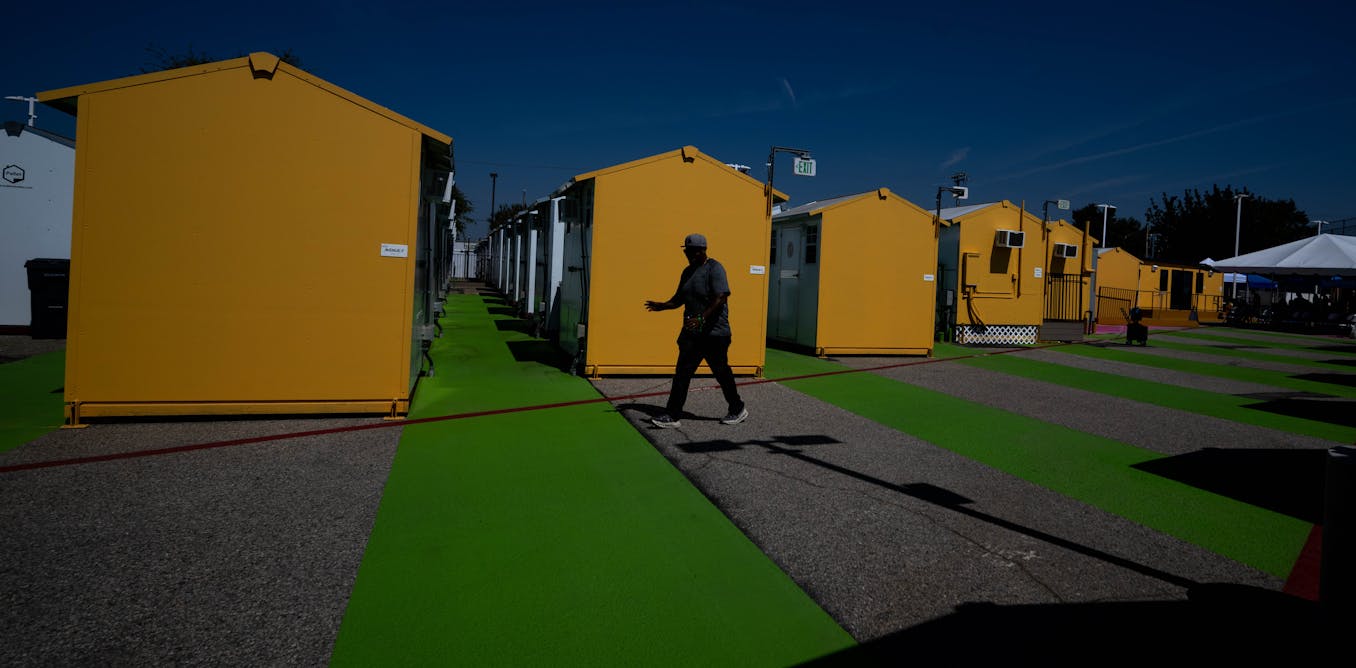
A person walks by means of a tiny dwelling village in Solar Valley, Calif., on Aug. 10, 2026.
Sarah Reingewirtz/MediaNews Group/Los Angeles Day by day Information by way of Getty Photographs
Latest inhabitants estimates present that Charlotte, North Carolina, is the fastest-growing giant metropolis in america. Town added greater than 20,000 residents between 2024 and 2025 and is quickly approaching a inhabitants of 1 million.
Charlotte has turn into a magnet for companies and residents searching for alternatives and a decrease value of dwelling.
However as Charlotte grows, its infrastructure is turning into more and more strained. The pressures of inhabitants progress are evident within the metropolis’s housing disaster. In 2026, 2,018 folks have been experiencing homelessness, up from 444 the earlier 12 months.
As city researchers learning housing insecurity and concrete improvement, our work examines what occurs when speedy city growth outpaces cities’ capacity to shelter their most susceptible residents.
Charlotte’s housing pressures are usually not distinctive. They replicate a broader American urbanization wherein speedy financial progress and concentrated wealth coexist with persistent housing inequality.
And we’ve discovered that communities throughout the U.S. are more and more responding to this affordability disaster with resident-led alternate options.
The housing disaster
For Charlotte renters, housing prices have risen significantly. Median lease within the metropolis elevated from US$1,146 a month in 2019 to $1,627 in 2024.
In the meantime, longtime residents in traditionally Black neighborhoods face mounting displacement pressures, as redevelopment and rising property values make it more and more troublesome for low-income residents to stay of their communities.
For households already dwelling on the financial margins, these pressures can imply the distinction between remaining housed and turning into homeless. The Charlotte-Mecklenburg space has about three extraordinarily low-income households for each rental unit reasonably priced to them. And for folks already experiencing homelessness, discovering a approach out has turn into tougher: The share of individuals leaving the homeless companies system for everlasting housing fell from 38% in 2020 to 25% in 2024.
The issue shouldn’t be that Charlotte and lots of different American cities are rising. It’s that these cities usually deal with progress itself because the coverage goal, whereas paying little consideration to who advantages from it and who doesn’t.
Tiny home villages
Our analysis exhibits that when infrastructure and housing markets can not accommodate unhoused populations, resident-led alternate options usually fill the hole.
Tiny home villages, for instance, signify a community-driven mechanism for folks to search out housing and neighborhood amid poverty and exclusion. These villages usually include clusters of small properties that present folks experiencing homelessness with shelter inside a shared neighborhood.
Relying on the village, residents may have entry to shared services and companies, corresponding to loos, kitchens and healthcare. These villages fluctuate significantly in how they function: Some present non permanent shelter, and others provide longer-term housing and pathways towards everlasting housing.
A 2024 examine that considered one of us carried out and that constructed on an earlier nationwide examine has allowed us to look at how tiny home villages throughout the nation have elevated over 5 years. The expansion was hanging: The variety of villages practically quadrupled, from 34 in 2019 to 123 in 2024.
This progress is especially notable as a result of the villages – usually spurred by nonprofit and faith-based teams – have emerged outdoors standard housing programs and are tailor-made to native circumstances. Within the U.S, these fashions are more and more supporting communities which are self-reliant out of necessity.
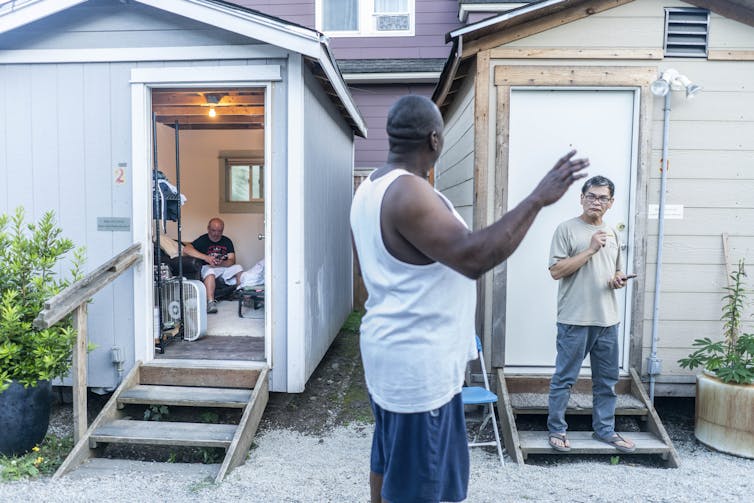
Residents converse at a self-managed tiny dwelling village for the homeless in Seattle on July 22, 2022.
Melina Mara/The Washington Put up by way of Getty Photographs
Portland’s Dignity Village
Dignity Village in Portland, Oregon, illustrates what this bottom-up response seems to be like. Housing some 60 residents, it grew out of an encampment established by homeless activists in 2000.
Dignity Village initially emerged as a tent metropolis on vacant metropolis land beneath a downtown bridge. At present, it has advanced right into a self-governed neighborhood of tiny properties. Residents handle the village and keep shared areas.
Folks searching for to dwell at Dignity Village have to be experiencing homelessness once they apply. As soon as admitted, residents turn into members of a neighborhood with its personal guidelines and elected management. Residents are usually required to contribute at the least 10 hours of labor per week towards working and sustaining the village. Exemptions can be found for individuals who work, attend college or are unable to take part.
The Metropolis of Portland supplies the land, however residents contribute to the prices of working the neighborhood by means of month-to-month program charges. Dignity Village additionally depends on personal donations, grants and revenue from microbusinesses to pay bills like electrical energy and waste removing.
Austin’s neighborhood and past
A really completely different tiny home mannequin has emerged in Austin, Texas.
A nonprofit developed Group First Village to supply everlasting, reasonably priced housing for folks popping out of power homelessness. In contrast to Dignity Village’s comparatively small, resident-governed neighborhood, Group First operates on a a lot bigger scale.
As of June 2026, greater than 500 folks lived there. That included greater than 455 individuals who had skilled power homelessness, and practically 50 “intentional neighbors” who selected to dwell locally alongside them.
The bigger nonprofit mannequin has attracted substantial personal and public funding, together with $35 million in federal COVID-19 pandemic-relief funds allotted by Travis County towards a further Group First website.
Comparable communities are rising throughout america. Only a few examples embrace Seattle, Los Angeles and Springfield, Missouri.
Entry to all
For a lot of the late twentieth century, the dominant problem dealing with American cities was managing inhabitants decline. City coverage targeted on attracting residents and funding again to locations hollowed out by suburbanization and deindustrialization.
At present, most of the nation’s fastest-growing metropolitan areas confront a distinct actuality. The proliferation of tiny home villages throughout the U.S. is happening at a time when many cities are attracting new residents and funding, whereas struggling to supply housing that continues to be accessible to all.
That is evident in Charlotte and in different fast-growing cities corresponding to Austin and Phoenix, the place inhabitants progress has occurred alongside persistent challenges round housing affordability and homelessness.

The authors don’t work for, seek the advice of, personal shares in or obtain funding from any firm or group that will profit from this text, and have disclosed no related affiliations past their educational appointment.